iot
Digital Twin Development: Why, When, and How?
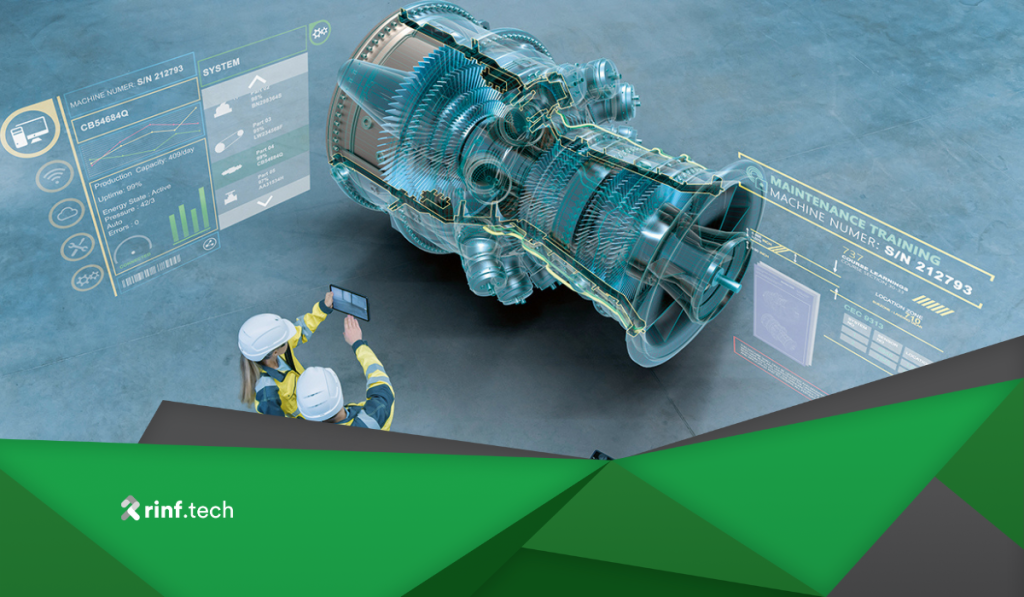
This article explores why and when businesses should consider building custom digital twins and what to take into account before jumping on the digital twin development project.

The global immersive technology market , valued at over $33.1 Billion in 2023, is projected to reach $170.2 billion by 2033 — and by 2026, enterprise adoption of Mixed Reality has accelerated well beyond consumer gaming and retail applications. Industrial manufacturing, automotive engineering, and aerospace are driving the most significant deployments, with measurable ROI already documented at BMW, Airbus, Siemens, and Volvo. What makes this moment different is the convergence of MR with AI — turning static overlays into context-aware assistance that understands what you’re looking at, reads live telemetry, and adapts guidance in real time.
Mixed Reality is currently the least explored of immersive technologies. While we are beginning to delve into MR through AR advancements, significant development is still needed to achieve fully optimized MR experiences.
The article explores how immersive technologies are transforming digital experiences by merging physical and virtual worlds, driven by advancements in AI, cloud computing, and powerful devices. It’ll highlight the rapid market growth, key applications across various industries such as retail, healthcare, education, and more, and delve into the potential and challenges of Mixed Reality as the least explored but highly promising segment of immersive technologies.
Before diving right into MR, let’s step back and get some definitions out of the way.
The term “immersive technology” describes the process of creating, displaying, and interacting with content in a new way. By combining AR, MR, VR, and haptic technologies like “3D touch” or “kinesthetic interaction,” immersive technologies are transforming digital experiences.
By combining users’ sight, touch, and sound, immersive technologies enable people to feel like part of a simulated artificial environment. Creating these experiences requires cutting-edge hardware, such as VR headsets, and advanced software.
The impact of immersive technologies is already visible across various industries. From enhancing customer engagement in retail to providing advanced training modules in education, these technologies are offering new ways to interact with digital content. Businesses are leveraging these advancements to create more engaging and effective solutions for their customers and employees.
More and more companies are adopting these technologies, highlighting the rapid integration of immersive technologies across various sectors. This adoption is driven by advancements in AI, cloud computing, and more powerful and versatile devices.
According to Peekpro, 40% of AR applications will enhance customer engagement in retail and e-commerce, significantly impacting shopping experiences by allowing customers to visualize products in their environment before purchasing. This trend has already shown a 30% increase in customer engagement and a 25% reduction in product returns for companies like IKEA.
Furthermore, 60% of VR applications will focus on training and educational purposes. VR training modules have demonstrated a 275% increase in trainees’ confidence when applying new skills and a fourfold improvement in knowledge absorption compared to traditional classroom training.
Boeing incorporated MR-based maintenance solutions, enabling technicians to access real-time data and instructions hands-free, resulting in a 20% decrease in maintenance time and a 15% increase in operational efficiency.
These are just some of the cases proving the transformative potential of immersive technologies across various sectors, showcasing their ability to enhance productivity, engagement, and efficiency. What’s new in 2026 is how AI converges with these technologies — turning static MR overlays into context-aware assistants that understand what you’re working on.
Although MR is the rising star of immersive technologies, it’s also the least understood. The confusion often arises because MR combines the key benefits of both AR and VR and transforms them into one incredible experience.
According to Microsoft, MR is a fusion of both physical and digital worlds that will help unlock natural and intuitive 3D computer, human, and environmental interactions. It’s possible today because of recent advancements in graphical processing, computer vision, cloud computing, input systems, and display technologies.
The global MR market has continued its rapid growth, now projected to expand from approximately $2.13 billion in 2023 to a staggering $64.87 billion by 2032. This growth is driven by increasing investments and advancements in 5G technology and IoT, which enhance MR applications across various sectors.
These technologies will play a pivotal role in enhancing real-time environment tracking, personalized content creation, and system performance optimization. Integrating 5G and cloud computing will enable seamless and responsive MR applications, enabling greater adoption and innovation across various industries.
The way MR works is quite like AR. However, its applications have evolved in recent years because of the development of smart systems and tools that enable deeper interactions between humans, computers, and objects.
MR depends heavily on the rapidly evolving human and machine relationship. To work, MR tools and applications must understand different human actions within a specific digital space and the surrounding landscape.
With the help of multiple cameras, sensors, and Artificial Intelligence (AI) technologies, we can process massive amounts of data about a specific space and leverage that information to deliver digitally enhanced experiences in near real-time.
For example, whenever we wear a pair of MR glasses, the cameras and sensors in those glasses get to work collecting and distributing data to an application that is basically creating a virtual map of our physical world. This approach enables the creation of holographic images and content we can include in our reality through image projections.
For MR technologies to work effectively, they need to be able to track:
Cloud computing enables the rapid processing of advanced input sensing. At the same time, environmental perceptions enable MR applications to merge our physical world with a virtual one successfully. We can do this in a manner that goes far beyond the means of AR technologies.
By 2026, on-device AI has transformed what MR headsets can do locally. Real-time object recognition, environment understanding, and natural language processing all run on the headset itself — eliminating the cloud dependency that limited earlier MR deployments. This means the headset doesn’t just track where you look; it understands what you’re looking at.
MR can break away from AR-related limitations to closely connect both virtual and real worlds. Let’s explore some MR use cases to see what’s already possible with this cutting-edge immersive technology.
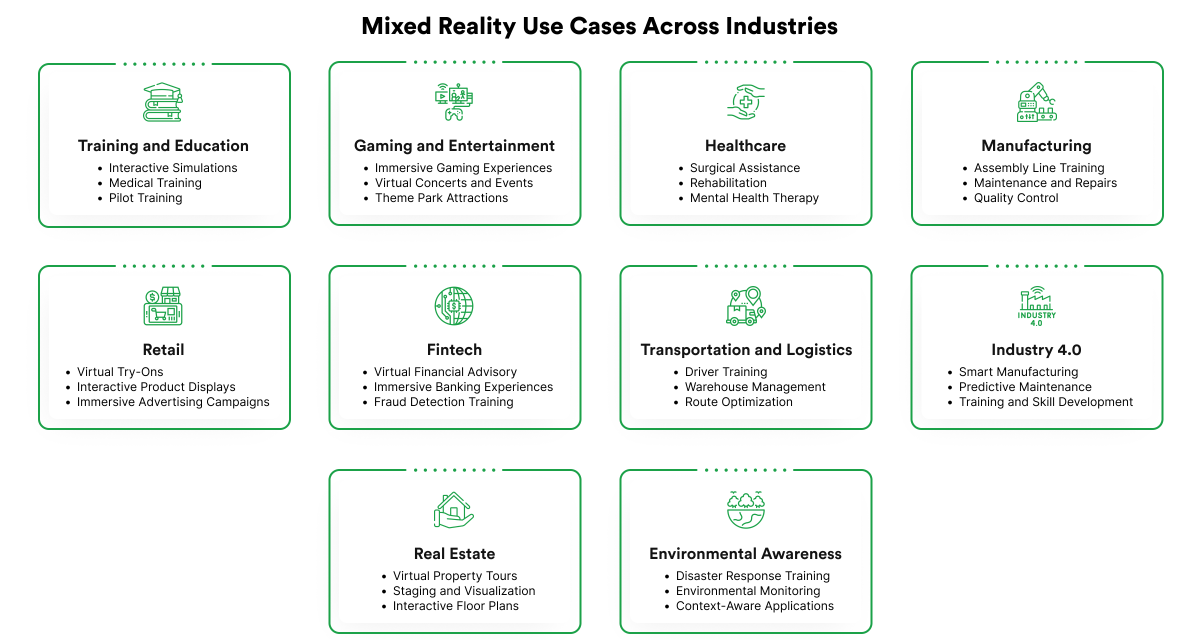
The use of virtual environments for training in various industries is made possible by mixed Reality (MR) technology. Through immersive learning experiences, MR in education helps pupils better comprehend and remember difficult material. For instance, during medical school, aspiring surgeons might simulate surgical procedures before performing on actual patients, allowing them to develop their abilities and earn critical experience hands-on.
Students can actively participate in and engage with educational content by benefiting from interactive learning experiences provided by MR technology. Students can learn complex concepts by incorporating interactive elements like 3D models, holograms, and simulations. This method promotes critical thinking and problem-solving abilities while encouraging a deeper degree of understanding.
By bringing the past to life and allowing students to explore different environments and periods, MR creates chances for virtual field trips and historical recreations. Through MR, students can visit historical locations, relive significant historical events, and engage with virtual people and objects. Students’ involvement is increased, and they form deeper connections to the subject matter thanks to this immersive teaching method.
Where AI changes the equation is in adaptive training. Static MR training shows you the same sequence every time. AI-powered MR training watches what you do, identifies mistakes, and adapts the lesson in real time. If you put a gasket in backwards, the system doesn’t just show you step 4 again — it recognises the error, explains why it matters, and offers corrective guidance. This turns MR training from a recorded video into an intelligent tutor that meets each trainee where they are.
Mixed Reality has completely changed how people play video games by enabling immersive gameplay that blurs the lines between the real and virtual worlds. Players can interact more realistically and interactively with virtual worlds and characters. Whether played on mobile devices with AR capabilities or headsets like Microsoft HoloLens, MR gaming offers a new degree of immersion and engagement.
Gamers may now overlay virtual characters and items onto their surroundings thanks to the widespread use of augmented reality in mobile gaming. This technology has been successfully applied in games like Pokémon Go, where players may capture virtual critters in their real-world surroundings. AR gaming encourages social connection, exploration, and physical activity.
Immersive and thrilling Adventures are offered to tourists at virtual reality theme parks and experiences. Virtual reality (VR) headsets and motion-tracking technology are frequently used in these parks to transport visitors to virtual worlds where they may engage in various activities, including simulated roller coaster rides, extreme sports, or interactive storytelling experiences. VR theme parks provide distinctive entertainment that is enjoyable to all ages.
AI is pushing MR gaming further — NPCs that remember your play style, dynamic storylines that adapt to your choices, and real-time object recognition that blends virtual characters with your actual environment more convincingly than ever.
Mixed Reality has proven to be very effective in training and simulations for surgery. Surgeons can rehearse complex procedures in virtual environments by simulating real-world situations without the risk of operating on live patients. They may improve their abilities, enhance patient safety, and improve their decision-making skills by using MR technology.
Applications for mixed Reality can be useful in rehabilitation and physical therapy. Patients recovering from physical injuries or disabilities can benefit from interactive activities and simulations offered by MR. MR technology makes therapy sessions more motivating for patients to engage in them, speeds up their recovery, and improves their entire experience with rehabilitation.
MR has been used in strategies for pain control and distraction. MR diverts patients from discomfort and pain during surgeries or treatments by immersing them in virtual environments. Children receiving injections, for instance, might be taken to a virtual aquatic habitat where they can engage with sea life, reducing their fear and distress.
AI enhances healthcare MR by analysing patient anatomy in real time during surgery, flagging anomalies that a surgeon might miss, and adapting rehabilitation exercises based on patient progress tracked through the headset’s sensors.
Mixed Reality lets designers and architects view their projects more realistically and engagingly. MR technology enables experts to evaluate design aspects, examine spatial linkages, and make well-informed decisions before construction starts by superimposing virtual architectural models onto actual spaces. Collaboration is improved, and the accuracy of design outcomes is increased through the visualization process.
Mixed Reality enables digital walkthroughs and design prototypes. Before any physical construction, architects and clients can examine digital representations of buildings and spaces to have complete knowledge of the design. Through MR, stakeholders can better communicate effectively and avoid making expensive design revisions by seeing the materials, lighting, and spatial arrangements.
MR improves remote interaction and collaborative design. Whatever their actual locations, architects and designers can work together online. This allows for seamless communication, immediate feedback, and the capacity for group design decisions. With distance no longer a barrier, international teams can work together successfully on architectural projects.
In the process of designing and prototyping new products, Mixed Reality is essential. Engineers can assess a product’s functionality, ergonomics, and aesthetics in a simulated environment by developing virtual representations. The iterative design saves time and money since real prototypes can be improved based on input from MR simulations.
Applications for mixed Reality are useful for training and assembly line optimization. Assembly line employees receive real-time assistance and instructions via MR technology, which lowers errors and boosts productivity. New hires can practice assembly jobs in a secure setting with virtual training modules, which shortens their learning curve and eliminates the need for physical training settings.
Through MR, remote help and maintenance are improved. Through MR technology, specialists may provide field workers with real-time advice, minimizing the need for on-site visits. Remote cooperation makes it possible to troubleshoot and solve problems more quickly, reducing downtime and enhancing the entire maintenance process.
AI takes MR in manufacturing from a better manual to an intelligent co-worker. Instead of static step-by-step overlays, AI sees what you’re doing and understands context. It recognises when you’ve installed a component incorrectly, answers natural questions like “why won’t this part fit?” by referencing live CAD data, and adapts procedures on the fly — if a screw is rusted, it offers the alternative method instead of leaving you stuck. It reads live sensor data and correlates it with what you see, spotting problems before they become failures. Without AI, MR is a well-lit instruction sheet. With AI, it’s an experienced colleague standing next to you.
Airbus has been using Microsoft HoloLens 2 across design and manufacturing since 2019, achieving 80% faster design validation and a 30% improvement in complex assembly tasks, with over 300 use cases identified across the enterprise (Microsoft News).
Fujitsu deployed Vuforia Engine on HoloLens for network equipment assembly, reducing assembly time from 120 to 97 minutes (19% productivity increase), cutting SFP transceiver installation from 53 to 31 minutes (42% improvement), and reducing operator training from 3-5 days to approximately 1 hour (PTC case study).
To help customers picture things before making a purchase, mixed Reality offers virtual try-on experiences. MR improves the shopping experience and lessens the need for real returns by enabling consumers to preview furniture in their own homes or try on virtual apparel. With this technology, shops may provide clients with individualized and practical solutions.
Mixed Reality makes it possible to shop and receive recommendations that are unique to you. Machine learning applications can examine client information, preferences, and past purchases to provide specialized product recommendations and shopping experiences. Retailers may establish tailored marketing efforts and increase customer satisfaction by knowing each customer’s preferences.
Mixed reality product demos that involve clients and produce memorable experiences. Through holograms, virtual tours, or interactive 3D models, MR can bring items to life. Thanks to this immersive approach, customers are drawn in and allowed to study things more dynamically and interestingly.
Mixed Reality helps with navigation and warehouse optimization. Real-time information and visual overlays can be provided by MR technology, aiding warehouse workers in finding products, maximizing available storage, and enhancing inventory control. This improves the warehouse’s efficiency and simplifies processes while reducing errors.
Drivers and operators can benefit from augmented Reality, which improves situational awareness and helps with navigation. Real-time data, like directions, speed, and traffic data, can be superimposed onto the driver’s field of view through MR headsets or windshield displays. The productivity of transportation professionals has increased overall, distractions are decreased, and safety is improved.
MR applications provide opportunities for supply chain management and visualization. MR makes it possible to see intricate supply chain networks, allowing managers to track and improve the flow of commodities, spot bottlenecks, and make informed decisions. This real-time visibility increases productivity, lowers costs, and boosts supply chain performance.
IoT integration and real-time data visualization are made easier by mixed Reality. MR technology can communicate with Internet of Things (IoT) devices and sensors to provide real-time data overlays on actual physical objects or settings. With the help of this interface, managers and operators may monitor and analyze data in real time, enabling predictive maintenance, streamlining workflows, and boosting overall efficiency.
Through Mixed Reality, remote machinery monitoring and maintenance are made possible. Technicians can get real-time access to equipment data, remote diagnostics, and detailed maintenance and repair instructions via MR devices. Thus, downtime decreases, maintenance effectiveness increases, and proactive troubleshooting is possible.
Virtual simulations and digital twins are used in manufacturing to make virtual versions of physical assets, procedures, or systems. Engineers and operators can model scenarios, test modifications, and improve performance using digital twins before practicing them in the real world. With this strategy, manufacturing sector risks are reduced, productivity is increased, and innovation is stimulated.
BMW’s Virtual Factory, announced in June 2025, projects up to 30% reduction in production planning costs by enabling collision checks and layout optimization in digital twins before physical changes are made (BMW Group).
Siemens’ Digital Twin Composer, unveiled at CES 2026, demonstrated a 20% increase in throughput on initial deployment with PepsiCo, identifying up to 90% of potential issues before physical build (Siemens). This capability is built on digital twin architecture, the same patterns we use across industrial deployments.
Applications for mixed Reality can improve online banking and financial services. Customers can communicate with virtual bank tellers or advisors, access banking services in virtual settings, and creatively visualize their financial data thanks to MR. Through improved accessibility and convenience, this technology enhances the client experience with financial assistance.
Mixed reality capabilities can be used to detect and prevent fraud. Many financial data sets may be analyzed by MR apps, which can also spot patterns and highlight possible fraud. MR enables analysts and investigators to spot and stop fraudulent transactions more efficiently by offering a more logical and interactive depiction of financial data.
Users may access virtual trading environments using mixed-reality investment and trading simulations. Without risking their money, traders and investors can test their tactics, examine market trends, and gain useful experience. Through MR simulations, people can hone their investment skills and make better decisions in the financial markets of the real world.
Mixed Reality is revolutionizing the real estate industry by providing immersive property tours that allow potential buyers to visualize properties as if they were physically present. Real estate agents can use MR to showcase multiple property options with interactive elements like changing room colors, moving furniture, or visualizing future renovations. This enhances the buying experience and saves time and resources by reducing the need for physical visits.
As hybrid and remote working models gain traction, MR is reshaping the way teams collaborate. Virtual workspaces created with MR enable team members from different corners of the world to convene in a shared virtual environment, using avatars and 3D interactive presentations.
In HR, MR is used for innovative recruitment processes and immersive employee onboarding. Candidates can undergo virtual job simulations to demonstrate their skills in realistic scenarios while new employees can receive interactive, hands-on training and orientation without physical resources. This approach speeds up recruitment and training and provides a more engaging and practical learning experience.
One significant challenge is integrating MR with existing legacy systems. Many industries, particularly manufacturing and healthcare, rely heavily on established technologies that may need to be more easily compatible with new MR solutions. Integrating MR requires extensive customization and sometimes complete overhauls of legacy systems, which can be both time-consuming and costly. This compatibility issue can slow down the adoption of MR, as companies must ensure that new MR applications can seamlessly work with their current infrastructure without disrupting ongoing operations. AI can help here — modernising legacy system interfaces through MR overlays that connect to existing databases via API middleware, without replacing the underlying systems. This is exactly the same methodology we use for legacy system modernization across exterprise environments.
MR applications generate vast amounts of data, including spatial maps, user interactions, and real-time analytics. The effective management of this data is a significant challenge. Organizations must develop robust data management strategies to store, process, and analyze the information efficiently. The failure to manage data properly can lead to information overload, where the sheer volume of data becomes unmanageable and hinders the decision-making process. This can have serious consequences, underscoring the importance of ensuring data accuracy and consistency while maintaining user privacy.
Latency issues can severely impact the effectiveness of MR applications. For MR to provide a seamless experience, real-time processing is essential. Any lag or delay in rendering digital elements or processing user inputs can disrupt the immersive experience and reduce the effectiveness of the application, particularly in critical scenarios like medical surgery or military training. Advances in 5G and edge computing are helping to mitigate these issues, but achieving consistently low latency remains a technical challenge.
Extended use of MR headsets can cause discomfort and health issues such as eye strain, headaches, and motion sickness. Ensuring user comfort is a major challenge, particularly for prolonged-use applications. Manufacturers are working on improving the ergonomics of MR headsets and developing technologies to reduce these adverse effects, but achieving a balance between immersive experience and user comfort is ongoing. Safety concerns include ensuring that users remain aware of their physical surroundings to prevent accidents and injuries.
MR applications must accurately interpret and interact with the user’s environment. This requires advanced spatial computing and environmental awareness technologies to map and understand physical spaces in real time. A complex technical challenge is ensuring that MR systems can adapt to dynamic environments, recognize context-specific elements, and interact with them appropriately. Failure to do so can result in a disjointed user experience where digital elements do not align correctly with the physical world.
Although MR development is currently going through a period of significant acceleration, some obstacles remain. However, the primary challenge is to overcome the fear of change. Other times it can also be the IT department’s lack of understanding or expertise.
However, once businesses realize the actual benefits of MR, convenience will override paranoia. But even then, MR will have a long way to go before it achieves large-scale adoption.
Mixed Reality (MR) is an evolving technology that combines elements of both augmented Reality (AR) and Virtual Reality (VR). Virtual reality (VR) and augmented reality (AR) are related but still developing technologies. Although MR improves AR by enabling virtual objects to interact with the real world, it still has several technical constraints. Making virtual things that accurately merge with the actual world while remaining smooth and realistic is one of the problems. Real-time tracking of the existing environment and accurate object occlusion are still technical challenges.
MR hardware has evolved rapidly and has become more affordable. But it remains in its infancy stage with limited battery life, discomfort when worn for an extended period, and a relatively small field of view. However, these challenges won’t last and will be resolved sooner rather than later. We also need more tools to support hands-free interaction and collaboration in digital spaces. Although speech is one way of overcoming this challenge, it can be unsuitable in a learning environment. On-device AI processing has reduced reliance on cloud connectivity, addressing some of the real-time tracking challenges at the hardware level.
The mainstream adoption of immersive technology, like substantial obstacles, including cost and accessibility, have hindered MR. Many people and organizations may not have access to these technologies due to the high hardware cost needed for MR experiences, such as headsets and sensors. For MR to promote greater accessibility, costs must be reduced, and cheaper MR solutions must be created. AI-assisted content creation tools are reducing the cost of developing MR training modules and environments, making enterprise MR deployments more accessible.
The development of hardware technology is essential to the success of mixed Reality. Hardware restrictions, such as a small field of view, bulky headsets, and limits on computational power, may impact the user experience. To improve the entire MR experience, it will be essential to upgrade the hardware infrastructure by making headsets lighter, more comfortable, and more powerful. 2026-generation headsets run AI models locally, enabling real-time object recognition and spatial understanding without cloud round-trips.
Another issue that needs to be solved is creating and integrating compelling and interesting MR content. Expertise in 3D modeling, computer vision, and spatial mapping are all necessary for creating virtual things and seamlessly incorporating them into the physical world. To guarantee a realistic and immersive experience, content creators must also consider elements like lighting conditions, object occlusion, and user interactions. AI-powered 3D model generation from photos and no-code MR authoring tools are significantly reducing content development time and cost.
Designing user-friendly user interfaces and methods of engagement with MR is a never-ending problem. Unlike conventional interfaces, MR interfaces must be incorporated into the environment and react to users’ motions and gestures in real time. A successful MR experience will depend on developing effective and organic interaction mechanisms that allow users to easily manipulate virtual objects, navigate interfaces, and complete actions. Natural language processing enables voice-controlled MR interfaces, letting workers ask “what’s the next step?” instead of navigating menus.
As with any new technology, privacy, and security issues are crucial. MR solutions may gather private user information, including gestures, biometric information, and location data. Gaining user trust and facilitating the mass adoption of MR will require ensuring effective privacy safeguards, secure data processing, and protecting user identities and information from potential breaches. AI processing on-device (rather than in the cloud) addresses key privacy concerns for enterprises handling proprietary designs or regulated data.
MR deployment involves several ethical questions. For instance, it is important to consider and deal with the possibility of addiction, social isolation, and psychological consequences on users. It is also necessary to set ethical rules and standards to prevent the exploitation of MR technology, such as intrusive data collection, unlawful surveillance, or the development of damaging or deceptive information. As MR+AI systems capture more user data, transparency about what the AI sees and stores becomes critical for ethical deployment.
The creation and deployment of MR technologies depend heavily on standardization and compatibility. The seamless integration and cooperation of MR devices may be constrained by the absence of globally recognized standards, which might impede interoperability between various hardware and software platforms. Common protocols and measures must be established to foster interoperability and enable the development of a more coherent MR ecosystem. AI middleware layers are emerging to bridge MR hardware platforms (Apple, Meta, Microsoft), reducing vendor lock-in.
Although there is increased interest in immersive technologies, there are still issues with user acceptance and adoption. Due to numerous considerations, including motion sickness, discomfort, or uncertainty regarding its practical applicability, some may need clarification or concern about utilizing MR. The key to accelerating user acceptance and adoption of MR will be educating consumers about the potential advantages, addressing usability challenges, and showing compelling use cases. As AI makes MR interactions more intuitive — answering questions, adapting to user behaviour — adoption barriers related to complexity are decreasing.
Energy efficiency and power consumption are crucial factors when developing MR equipment. The computational demands of the current MR gear result in high energy usage and short battery life. Extending usage time, enhancing portability, and lessening the environmental impact of MR technology will be possible by improving the energy efficiency of headsets, tracking systems, and other components. AI chip optimisations (NPUs) have improved power efficiency, extending headset battery life from approximately 2 hours (2024) to 4-6 hours in current-generation devices.
The future of Mixed Reality is not just promising; it’s on the brink of a transformative revolution, especially with the integration of AI, machine learning (ML), and other advanced technologies. AI and ML are set to redefine MR experiences, propelling them to unprecedented levels by enhancing real-time environment tracking, predictive maintenance, and personalized content creation.
AI algorithms can process and interpret vast amounts of data from the real world to create more accurate and responsive MR environments. This involves using computer vision and deep learning techniques to recognize objects, gestures, and spatial configurations, allowing MR applications to interact seamlessly with the physical world. For instance, AI can help MR systems dynamically adjust to changing environmental conditions, ensuring a smooth and immersive user experience. In 2026, this is no longer theoretical — Apple Vision Pro and Meta Quest 3 run real-time scene understanding on-device.
In industries such as manufacturing and healthcare, the potential of AI-driven predictive maintenance in MR devices is nothing short of game-changing. By analyzing data from various sensors, AI can anticipate equipment failures before they occur, thereby reducing downtime and maintenance costs. This proactive approach ensures that MR systems function optimally, enhancing reliability and effectiveness. AI-powered predictive maintenance integrated with MR headsets is now deployed in production environments, with documented results from Siemens and BMW.
ML algorithms excel at analyzing user interactions and preferences. In the context of MR, ML can be used to create highly customized experiences. MR can adapt learning modules to match students’ learning pace and style in education, making education more effective and engaging.
The advent of 5G technology and the continuous advancements in cloud computing are not just crucial. They are the solid foundation of the future of MR. 5G offers high-speed, low-latency internet connectivity, indispensable for real-time MR applications. This technology allows for the seamless streaming of high-resolution MR content and supports complex interactions without delays. Cloud computing, on the other hand, provides the necessary computational power to handle intensive MR tasks. It enables offloading heavy processing tasks to the cloud, making MR applications more accessible on lightweight devices.
Beyond AI and ML, other emerging technologies, such as blockchain and edge computing, are also set to impact the future of MR. Blockchain can provide secure and transparent data management solutions, which are critical for maintaining the integrity of MR interactions. Edge computing can reduce latency by processing data closer to the source, enhancing MR applications’ responsiveness.
Technological advancements continually push the boundaries of interactivity and immersion in MR. Innovations in haptic feedback, spatial audio, and advanced display technologies contribute to creating more lifelike and engaging MR experiences. These technologies allow users to interact with virtual objects naturally and intuitively, significantly enhancing the overall user experience.
As technology continues to evolve, becoming lighter, faster, and more affordable, Mixed Reality is moving from experimental to essential — especially when combined with AI that understands the physical world. The lines separating the physical and digital worlds are becoming less distinct each day, opening new possibilities in industrial manufacturing, automotive engineering, and beyond. The fusion of MR technology with AI-powered spatial intelligence has enormous promise for enterprises ready to move beyond static instructions to context-aware assistance.
We foresee significant benefits in manufacturing and engineering as MR+AI adoption accelerates. The ability to combine real-time AI telemetry with hands-free MR overlays allows businesses to reduce downtime, improve training outcomes, and increase first-time fix rates — with measurable results already documented at BMW, Boeing, Siemens, Airbus, and Volvo.
Whether you’re an industrial manufacturer exploring MR for digital twin visualization or an automotive OEM developing AI-powered remote maintenance workflows, rinf.tech’s team of skilled developers, designers, and strategists can provide the necessary guidance and expertise for your MR and AI initiatives.
Let’s talk.
This article explores why and when businesses should consider building custom digital twins and what to take into account before jumping on the digital twin development project.
This article focuses on the key technological changes enterprises need to make in order to support their innovation goals and how R&D can be an effective solution and a driver of IIoT success and sustainability.
Check out what it takes to build a highly effective digital cockpit solution and how it can benefit both car makers and Tier1 providers.