
The Stranger Who Knows Your Car Better Than the Salesman
The person selling you a car has rarely owned one, and the person who has is usually missing from the sale.
By rinf.tech, the engineering partner that developed the Carbassador platform.
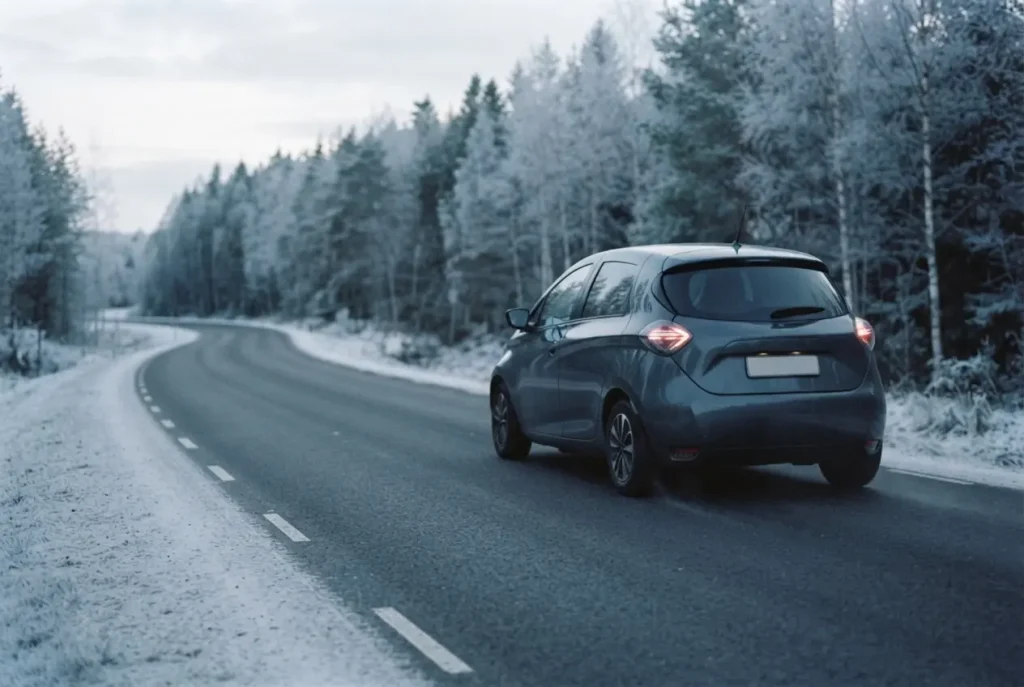
Picture a buyer in Oslo, three weeks from signing for a used electric MG. Let’s call him Alex. He has done his research, and the spec sheet lists the manufacturer’s official range: a figure, measured under test conditions. Oslo in winter is a different test. What Alex wants to know is how that number holds up on a January morning at minus ten degrees, with the heater running and studded tires on. The salesperson is unlikely to know, having probably not owned this car through a Norwegian winter. Nor does the spec sheet say. So who can he ask?
The obvious answer is the salesperson, and it is a reasonable one. A salesperson knows the spec sheet, from battery size and charging speed to trim levels and price. But the question about January isn’t on the spec sheet. It belongs to a different kind of knowledge, the kind held by someone who already owns the car and can say what the range was last winter, how the seats hold up, and which part went to the workshop first. Call the first the seller’s knowledge and the second the owner’s knowledge. They sound like two halves of one subject. In practice, they are separate, and a buyer with plenty of the first can still have very little of the second.
In 1970, an economist named Phillip Nelson published a paper in the Journal of Political Economy called “Information and Consumer Behavior”, and it gave this problem its vocabulary. Some products, he argued, can be judged before you buy them. Those he called search goods. Think of a shirt, which can be held up to the light and its stitching checked. Others reveal their quality only through use, and those he called experience goods. By that definition a car sits firmly in the second group. Much of what matters about it shows up months after the contract is signed, when the money has already been spent.
Professional reviews help less than you would expect, because conditions matter so much. A test drive filmed in Berlin, written for a market with a different climate and different roads, tells a Norwegian family very little about their own winter. What Alex needs is an owner whose daily driving resembles his, and for most buyers finding one has been a matter of luck, a neighbour or a colleague or a cousin who happens to own the same model. When a purchase goes badly, the market gets little warning. Disappointed buyers tend to justify the decision to themselves instead of telling other people about it. So the next buyer starts from the same place.
Online reviews seem to have solved this. Owner ratings exist for nearly every car on sale, with stars attached. The difficulty is that a five-star review from a username tells Alex what somebody claims. It doesn’t tell him whether the writer owns the car, or drives it in a climate like his, or is the person the profile describes. A salesperson in a showroom at least has a name and an employer. Yet that hasn’t earned much trust either. In Gallup’s survey of honesty and ethics across professions, 7% of Americans rated car salespeople highly, level with members of Congress and above only telemarketers. So the buyer is caught between a person he can identify but hesitates to believe, and a stranger he might believe but can’t identify.
What would it take to have both? That was the question behind Carbassador. Gill Group, the company behind it, bet that buyers would trust an owner more readily than a sales script, and commissioned the platform around that bet. Consider what a salesperson has traditionally supplied apart from information. A face, a name, and someone to hold responsible if things go wrong. Carbassador recreates each of those in software, through verified identity, role-based access, moderated communication and administrative oversight. rinf.tech developed that layer from start to finish.
Take identity first. In the showroom, the buyer can see who he is talking to. On Carbassador the equivalent is a check that happens before the conversation. An owner has to register a supported vehicle and pass ownership verification; only then can a buyer see the profile. Privacy comes next. A conversation with a salesperson happens between two people, and the platform maintains that arrangement by running the exchange through a moderated private chat instead of a public thread open to everyone. Access follows the same principle, so that buyers, owners and administrators each see what their role requires. And where a dealership has a manager, the platform has administrators who oversee the system as it grows.
The match itself begins with something a spec sheet doesn’t contain, which is the same model driven in real conditions by a person who owns it. What the platform establishes is narrow, and worth stating precisely. The identity behind an opinion has been verified, and no commission changes hands. That is more than a typical review offers. Whether a particular owner is right about a particular car is a separate question, and the platform doesn’t claim to answer it.
Does it work? The platform is young and the numbers are small, so they are best read as an early indication. By late August 2026, about a hundred buyers and sixty owners had registered. What stands out is what they did next. Roughly three in four, on both sides, opened the chat and used it. Those conversations produced 93 separate pairings of a buyer with an owner and 467 messages, which works out to about five messages for each pairing. That is enough for a question, an answer and a follow-up. Carbassador is live in Norway today, and a launch in Switzerland is planned for mid-October.
The same idea turns up in a setting with no cars in it. A Tier-1 global banking and financial services group had coordinated its credit operations cases by email for years. rinf.tech replaced the inboxes with one workflow platform, where each person’s access is set by role and drawn from systems the bank already relied on, and where records are archived automatically. The team’s monitoring workload fell by an estimated third. That was a coordination problem, with no sale involved. Underneath, it was the same problem of people needing to rely on each other without checking every detail themselves.
There is a cost buried in all of this, and it rarely gets a budget line of its own. It is the cost of getting a stranger to trust a transaction enough to complete it. Companies have long paid for it through people, in commissions, in headcount, and in the staff who moderate reviews. Carbassador suggests the same trust can be built once, out of a verified identity, a private channel and an administrator overseeing the system. That raises some awkward arithmetic for whoever signs off on a sales budget. How much of that spending is really buying trust? What does a completed transaction cost today, commission included, set against the one-time cost of building that layer? And what would it take to build in-house, given that this one took twelve people and fourteen months?
Go back to Oslo. Alex still has three weeks, a spec sheet and a question about January. The salesperson can tell him what the car is. An owner who drove the same model through last winter can tell him what the car does. Until recently, whether those two people met was mostly a matter of luck. What has changed is that somebody decided the meeting was worth building. The owner may turn out to be wrong, of course. But Alex will know who is answering, and that the answer isn’t being paid for. For a purchase he will largely come to understand after he has made it, that may be the most useful thing he can know beforehand.