V2X: Path to a Safer, Smarter, and More Connected Driving Experience

Vehicle-to-Everything (V2X) communication is a comprehensive technology designed to enhance the interaction between vehicles, infrastructure, pedestrians, and the broader network. By enabling this multidimensional exchange of information, V2X strives to create a safer, smarter, and more efficient transportation system. The main goal of V2X is to minimize road accidents, improve traffic management, and pave the way for more advanced autonomous driving capabilities. At rinf.tech, our automotive software development team builds connected vehicle solutions that leverage V2X communication for safer and smarter mobility.

At its core, V2X is about creating a connected ecosystem where vehicles can communicate seamlessly with each other, traffic signals, road signs, pedestrians, and even the cloud. The global automotive V2X market was valued at $1.91 billion in 2024 and is projected to reach approximately $80.49 billion by 2034. The growth is fueled by the rising demand for vehicle safety features and improved traffic management systems.

The Tampa Connected Vehicle Pilot demonstrated V2X’s life-saving potential in a real-world urban setting. In one incident, a vehicle approaching an intersection at high speed was detected by the V2I system, which responded instantly to prevent a collision. Over 1,000 participants used V2V and V2I solutions across downtown Tampa, resulting in a 9% reduction in forward collision conflicts, a 23% decrease in emergency braking, and improved travel times — providing a clear glimpse into the potential of fully connected urban traffic systems.

Contents

V2X in Action

Rapid Detection and Response 

During the Tampa Connected Vehicle Pilot, V2X technology demonstrated its potential to detect and address safety-critical situations in real-time. The system employed in downtown Tampa could identify unusual vehicle behaviors, such as high-speed approaches or erratic movement near intersections. For instance, when vehicles approached intersections at unsafe speeds, the V2I system utilized advanced sensors and analytics to recognize these behaviors as potential hazards. By detecting these anomalies instantly, the system could promptly activate safety measures to protect road users. This ability to rapidly identify speed anomalies showcased how V2X technology adds a crucial layer of safety to the urban driving environment.

Infrastructure Coordination 

In addition to detection, the V2X system’s capability to coordinate with infrastructure elements in downtown Tampa played a vital role in accident prevention and traffic management. The V2I technology implemented in the pilot featured signal prioritization, dynamically adjusting traffic lights to control the flow around intersections. This feature proved especially effective in temporarily halting cross-traffic when a potential hazard was detected, preventing vehicles from entering the intersection. Additionally, the system integrated with public transit to offer signal priority to buses, facilitating smoother traffic flow and improving operational efficiency. This infrastructure coordination highlighted V2X’s potential to enhance urban safety and efficiency, especially in high-density traffic areas.

Safety and Efficiency Outcomes 

The Tampa pilot provided valuable insights into how V2X can create safer driving environments and produce measurable safety improvements. For example, a 9% reduction in forward collision conflicts and a 23% decrease in emergency braking incidents were observed, underscoring V2X’s effectiveness in preventing accidents through timely alerts and smoother interactions. Although some false positives occasionally limited the system, the broader benefits of V2X deployment for real-time traffic management were clear. Additionally, the pilot showed that V2X could reduce travel times by 2.1% and idle times by 1.8%, contributing to more efficient commutes. With 56% of participants expressing satisfaction, the Tampa pilot underscored V2X’s potential to support safer, faster roadways and foster a positive user experience, setting the stage for wider implementation in urban centers.

Key Types of V2X Communication


V2V (Vehicle-to-Vehicle) 

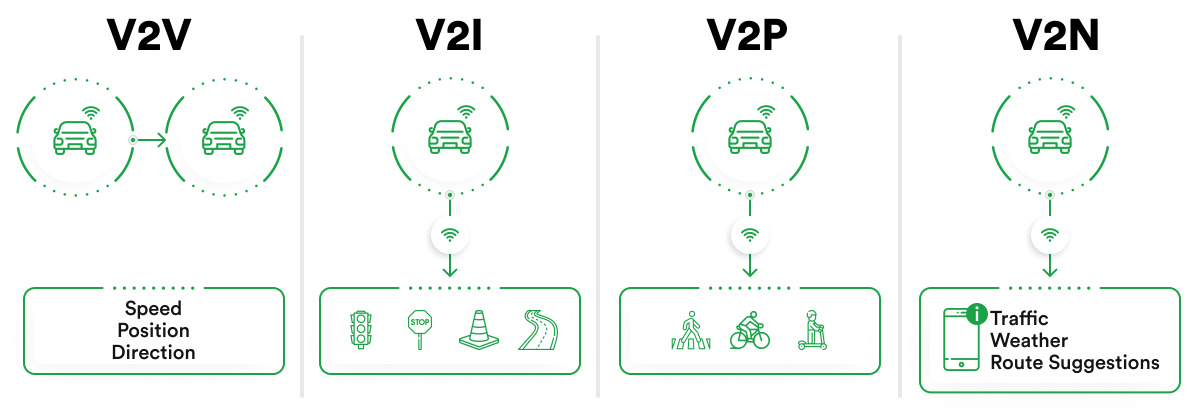
V2V enables direct, real-time data exchange between vehicles within close proximity. Through dedicated short-range communication (DSRC) or cellular-based links, vehicles share information about speed, position, braking status, and steering angle. This allows for cooperative collision avoidance, emergency braking alerts, and intersection movement coordination without relying on fixed infrastructure. V2V is foundational for platooning applications, where trucks maintain close formation to reduce aerodynamic drag and improve fuel efficiency.

V2I (Vehicle-to-Infrastructure) 

V2I connects vehicles with roadside infrastructure such as traffic signals, toll booths, road signs, and adaptive message boards. Traffic signal phase and timing (SPaT) data allows vehicles to receive green light optimal speed advisories (GLOSA), reducing unnecessary stops and improving traffic flow. V2I also enables real-time hazard warnings from infrastructure sensors, alerting drivers to road works, accidents, or adverse weather conditions ahead.

V2P (Vehicle-to-Pedestrian) 

V2P communication protects vulnerable road users by enabling vehicles to detect and communicate with pedestrians, cyclists, and other non-vehicle entities through their mobile devices or wearables. The system broadcasts the pedestrian’s position and trajectory while the vehicle shares its speed and intended path. In scenarios where line-of-sight is obstructed — such as a child stepping out from behind a parked vehicle — V2P provides critical advance warning to both driver and pedestrian.

V2N (Vehicle-to-Network) 

V2N connects vehicles to cloud platforms and back-end traffic management systems via cellular networks (4G/5G). This enables wide-area services such as real-time traffic rerouting, over-the-air (OTA) software updates, remote diagnostics, and streaming HD map data for autonomous driving systems. V2N is the gateway for vehicle integration into smart city ecosystems and transportation-as-a-service (TaaS) platforms.

The C-V2X Standard

Cellular Vehicle-to-Everything (C-V2X) is a global standard defined by 3GPP that uses 4G LTE and 5G NR cellular technologies for V2X communication. Unlike DSRC (IEEE 802.11p), C-V2X benefits from the existing cellular infrastructure and provides better range, non-line-of-sight performance, and a clear migration path to 5G. The ISO 19079 standard governs intelligent transport system station management for C-V2X, ensuring interoperability across different implementations and regions.


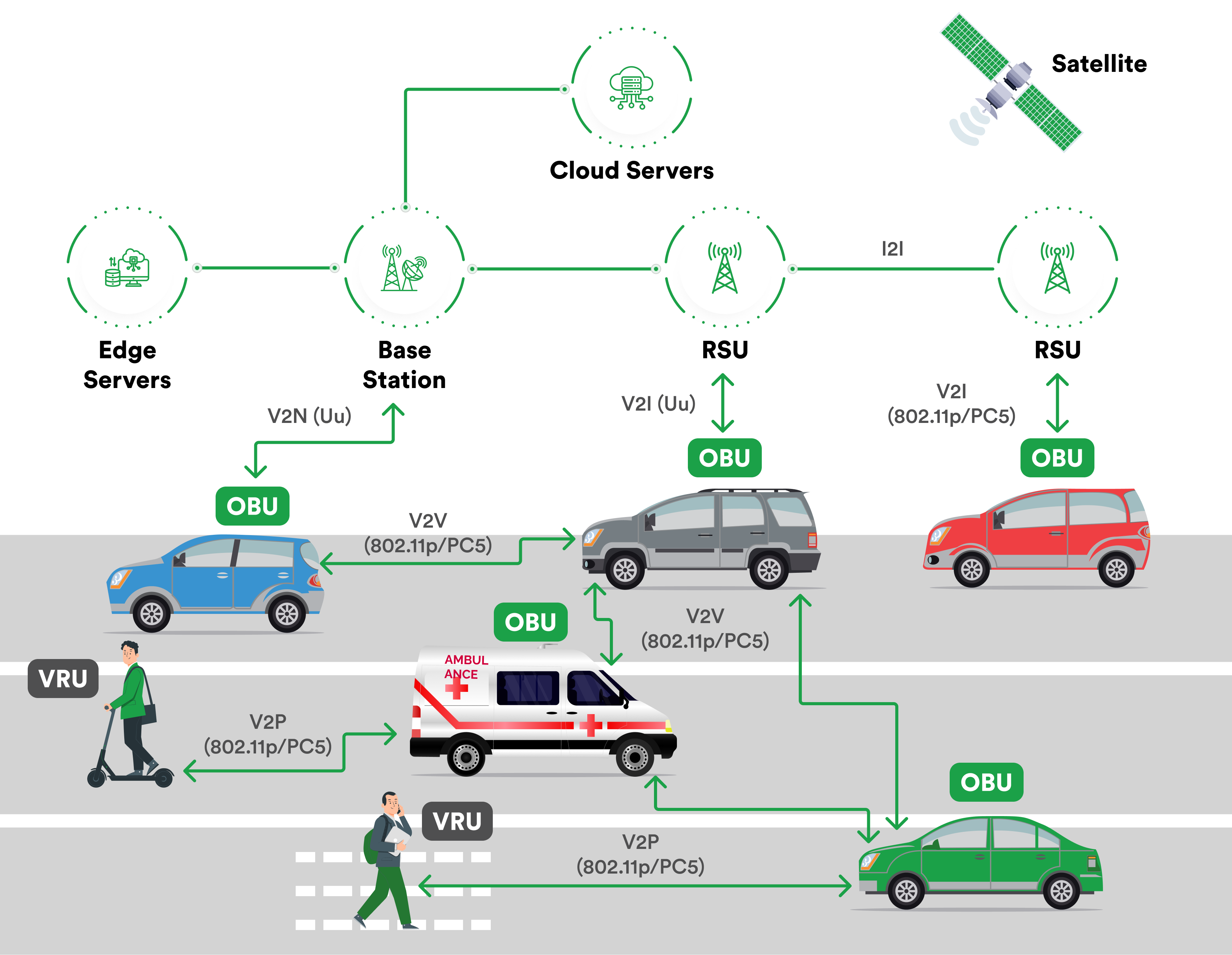
V2X (Vehicle-to-Everything) connectivity modes

V2X (Vehicle-to-Everything) Connectivity Modes

Benefits and Applications of V2X

V2X communication offers numerous benefits that extend beyond just enhancing vehicle connectivity. Its ability to improve road safety, optimize traffic flow, and support the advancement of autonomous driving makes it a cornerstone of future transportation systems.  

Enhanced Road Safety 

One of the most significant benefits of V2X communication is its ability to prevent accidents by providing drivers and autonomous systems with critical information in real time. For example, V2X systems can avoid collisions by alerting drivers of nearby hazards, such as stopped vehicles, slippery roads, or approaching emergency vehicles. Blind spot warnings and hazardous condition alerts also play a crucial role in reducing the likelihood of accidents.

Improved Traffic Efficiency 

V2X communication optimizes traffic flow by coordinating vehicles and infrastructure. Prime examples include adaptive cruise control systems that adjust vehicle speed based on real-time traffic data and traffic signal coordination that minimizes wait times at intersections. These technologies can significantly reduce fuel consumption by reducing idle time and improving overall driving efficiency. The optimization of traffic flow through V2X communication has also been associated with lower CO2 emissions. Studies have shown that smart signal timing can reduce emissions by 32% to 40%. 

Automated Driving Support 

As autonomous vehicles (AVs) become more prevalent, V2X will enhance their capabilities by providing them with a broader situational awareness. For example, by communicating with other vehicles and infrastructure, V2X can help AVs coordinate their maneuvers, such as merging into traffic or making unprotected turns. This cooperative driving allows AVs to navigate complex environments more efficiently and safely. The collaborative nature of V2X is also vital for platooning, where vehicles drive closely together in a coordinated manner to reduce drag and improve fuel efficiency. 

Looking for a trusted, proven partner in software development and technology integration to drive your automotive projects forward?

Technical Challenges and Solutions

Standardization and Interoperability

Different regions have adopted various standards for V2X communication, such as ITS-G5 in the EU, C-V2X in China, and IEEE 802.11p in North America, which complicates global interoperability.

Solution: Ongoing collaboration between regional regulators and industry stakeholders is necessary to align communication standards and security protocols, ensuring seamless V2X adoption worldwide.

Communication Reliability and Security

V2X networks face challenges with communication reliability, especially in adverse weather conditions or dense urban settings, and are also vulnerable to cyberattacks.

Solution: Implementing robust encryption, authentication mechanisms, and secure communication channels can protect data integrity and ensure reliable V2X performance, even under challenging conditions.

Bandwidth Limitations and Network Congestion

As V2X systems expand, the volume of real-time data exchange grows, especially in high-density urban areas where network congestion can impact bandwidth availability.

Solution: Dynamic bandwidth allocation, edge computing, and data compression can help manage data loads, ensuring that safety-critical information is transmitted reliably even in congested environments.

Latency and Real-Time Processing Requirements

Low latency is crucial for V2X applications, particularly in scenarios where real-time decisions are essential, such as collision avoidance. Traditional networks may struggle to meet these ultra-low latency requirements.

Solution: Deploying 5G networks, dedicated short-range communication (DSRC) systems, and optimized network architectures can provide the necessary infrastructure to support real-time responsiveness.

Power Consumption and Battery Life in Connected Devices

V2X communication relies on various connected devices, from in-vehicle units to roadside sensors, which require stable power. High power consumption can lead to frequent maintenance or device failures, disrupting V2X operations.

Solution: Developing energy-efficient hardware, using low-power communication protocols, and exploring energy-harvesting technologies can extend battery life and reduce maintenance needs.

The Role of 5G in V2X

The introduction of 5G technology will be a game-changer for V2X communication, providing the foundation for more advanced, reliable, and high-performance applications. With its ultra-low latency, high bandwidth, and greater capacity for device connectivity, 5G enhances V2X’s capabilities, enabling faster and more efficient data exchanges between vehicles, infrastructure, pedestrians, and networks. 

Reduced Latency 

One of the most significant advantages 5G brings to V2X is the reduction in latency, which is crucial for real-time communication in safety-critical situations. In a V2X ecosystem, milliseconds can make a difference between a collision and an accident averted. With 5G, vehicles can receive and process data almost instantaneously, allowing for quicker reactions to hazards such as sudden braking, dangerous road conditions, or the unexpected movement of pedestrians. This real-time data exchange supports life-saving applications like emergency vehicle alerts, collision warnings, and lane change assistance. 

Real-time HD Map Updates 

Beyond road safety, 5G enables the development of more sophisticated applications that require massive data transfers. For example, 5G can support real-time high-definition (HD) map updates, allowing vehicles to have an accurate understanding of their surroundings at all times. This capability is significant for autonomous vehicles, which rely on detailed, up-to-date information to navigate complex environments.  

Remote Driving and Scalability 

In addition, 5G can enable remote driving applications, where vehicles can be controlled from a distance in environments that are too dangerous for humans. Another critical benefit of 5G in V2X is its ability to handle the growing number of connected devices on the road. As smart cities evolve and more vehicles become connected, the demand for data transmission will increase exponentially. 5G networks are designed to support many connected devices simultaneously, ensuring that V2X communication remains reliable even in densely populated urban areas with high connectivity demands. 

INternet of Vehicles solutions
V2X Connectivity Modes Composing Internet-of-Vehicle Paradigm

The Future of V2X

The future of V2X communication is closely tied to the development of smart cities, intelligent transportation systems, and the rise of autonomous vehicles. As the world shifts towards connected ecosystems where data flows seamlessly between vehicles, infrastructure, and people, V2X is set to become the backbone of next-generation transportation networks. In the coming years, we can expect V2X technology to evolve significantly, playing an even more pivotal role in enhancing road safety, optimizing traffic management, and fostering sustainable urban mobility. 

Smart City Infrastructure 

One of the most exciting prospects for V2X lies in its integration with smart city infrastructure. As cities adopt more intelligent transportation systems, V2X will serve as the communication bridge that enables real-time coordination between vehicles and urban infrastructure. This coordination will facilitate better traffic flow management, reducing congestion in busy metropolitan areas. With V2X, traffic lights, road signs, and even parking spaces could become dynamically responsive, adjusting based on real-time conditions and the needs of connected vehicles. Such systems would improve the efficiency of urban mobility and help reduce the carbon footprint by minimizing stop-and-go traffic and unnecessary idling. 

V2X and Autonomous Vehicles  

Autonomous vehicles (AVs) will also rely heavily on V2X communication to navigate the complexities of modern roads. While AVs are equipped with sensors and cameras, V2X provides an additional layer of situational awareness, enabling AVs to communicate with other vehicles and infrastructure in ways that cameras and sensors alone cannot. Complementing V2X communication, AI-powered LiDAR enhances perception for autonomous systems. Learn more about our automotive software development capabilities for connected and autonomous vehicles.

Energy Optimization 

As electric vehicles (EVs) continue to grow in popularity, V2X will play a vital role in optimizing energy usage and integrating vehicles into the smart grid. V2X communication can help EVs coordinate with charging stations, ensuring they charge during off-peak hours when energy demand is lower. This energy optimization is essential as more EVs enter the market and cities move towards sustainable energy solutions. Additionally, the advent of Vehicle-to-Grid (V2G) technology, a subset of V2X, could allow vehicles to share stored energy with the grid, contributing to energy stability in smart cities. 

AI and ML Integration 

Furthermore, as artificial intelligence (AI) and machine learning become increasingly integrated into transportation systems, V2X communication will enable more predictive and proactive transportation networks. AI-driven V2X applications could anticipate traffic patterns, predict accidents, or optimize routes based on real-time data from vehicles and infrastructure. In the context of smart cities, this will contribute to a more fluid and responsive transportation ecosystem where human-driven and autonomous vehicles operate with higher efficiency and lower environmental impact. For more on the broader technology landscape, see our Automotive and Embedded Technology Trends.

Conclusion

V2X communication is expected to be a transformative force in the evolution of transportation, revolutionizing how vehicles, infrastructure, and people interact in a connected ecosystem. This technology’s potential to significantly enhance road safety, improve traffic efficiency, and support the development of autonomous driving makes it an essential component of tomorrow’s mobility solutions. By enabling real-time data exchange among vehicles, roadside infrastructure, pedestrians, and network systems, V2X lays a strong foundation for safer roads, smoother traffic flows, and a more integrated driving experience. 

Looking to the future, V2X is expected to play a key role in smart city development, with widespread adoption projected over the next decade. Large-scale V2X implementations could become mainstream within urban centers in the next 10 years, especially as global standards and policies continue to align. Cities investing in intelligent transportation systems increasingly incorporate V2X technology, likely forming a critical component of urban infrastructure upgrades over the next 5-10 years. As these deployments expand, V2X is set to become the backbone of interconnected, intelligent urban landscapes, enabling vehicles to communicate seamlessly with traffic lights, road signs, and emergency response systems in real time. 

For organizations seeking to capitalize on V2X’s vast potential, now is the time to invest. Whether involved in autonomous driving solutions, smart city infrastructure, or fleet management, V2X will be a critical enabler of innovation and operational efficiency. The road to fully integrated V2X ecosystems is unfolding, and companies positioning themselves early stand to be leaders in the mobility revolution, contributing to a safer, more efficient, and sustainable future for transportation. 

Looking for a technology partner?

Let’s talk.

Related Articles

custom lidar solutions development
ai

AI-Powered LiDAR: A New Era of Perception

How AI and ML enhance LiDAR technology by overcoming data processing challenges, enabling advanced applications in autonomous systems, robotics, and 3D mapping, and more.